Thursday, October 28, 2010

[Annotation blog post #8] . "International Trade” and "The Do’s and Taboos of international trade"

1) This time, I will choose two different sources but they talk about similar topics. First book is “International Trade”, the second one is “The DO’s and TABOOS of international trade.” I read few chapters from these two sources, and found some interesting matters around international trade. First one is the cultural barrier, which language and cultural background in particular.
2) Quotes:
• “Communication in international business is both a skill and an art requiring special, new sensitivities.”
• “…mis-communication can be the enemy.”
3) For language, if one business intends to expand business internationally, they should concern about the cost of information transfer (such as using translator, interpreter.) The different in language can cause to humorous situations, worst case is misinterpret/misunderstand with your business partners. For culture background, business should think about the differences in “national characters” and “traditional customs” that affect the customer’s preference.
4) Learning how to communicate appropriately is a process that requires the sensitivities and eager to learn new cultures. As this source gives some specific examples about the situation that a company/individual encounters with culture conflicts (some results are humorous, some cause the relationships to be damaged, messages are misunderstanding or misinterpreting.)
5) The author of “The Do’s and Taboos of international Trade” is Roger, who started to approach international trade at first as a student of culture and tradition, and later worked as a company representative. And for “International Trade”, the authors are the specialized in international trade and spends years working and studying about culture factors.
6) Few topics I have so far is: intercultural communications, cross-culture understanding, the ethnic minority business (women in particular.) I think these issues somehow can give me the answers for my concern about the difficulties that an internally educated business woman can encounter if she comes back to her home country.

Work cited:

Axtell, Roger E., and Tommy G. Thompson. The Do's and Taboos of International Trade: a Small Business Primer. New York, NY: Wiley, 1994. Print.
Jepma, C. J., and André Rhoen. International Trade: a Business Perspective. London: Longman, 1996. Print.  

Wednesday, October 27, 2010

[Annotation blog post #7] Silent Contributors: Asian Female Entrepreneurs and Women in Business - Spinder Dhaliwal

1) The author talks about the growth of Asian female entrepreneurs in business, particularly in British. The author brings up the possible reasons that may cause women to enter self-employment, and one of them is discrimination, the stereotypes about women working in as a businesswomen. Children, family are few things women should concern about when they decide to be self-employment. Finally, the author mentions the important of the policy makers to recognize the diversity within businesses and take into account the female role, create equal both in race and gender.
2) Quotes:
a. “She feels that being an Asian woman can be a liability, with many clients wanting to deal with men when it comes to business and financial matters.” (468)
b. “One of the main reasons given in writings on the subject is that many South Asians go into self-employment as a response to “blocked upward mobility.” (465)
c. “The businesses were initiated as more of a pastime and challenge, a hobby, to occupy them once their children were at school or had left home, rather than a financial and economic necessity.” (467)
3) There are lots of distributions from the minority group, women in particular. I think in Vietnam, people start to be more open-minded, especially people from the big cities, the big trading centers, but for the rural areas, there are still thousands and thousands of women have to stay home, take care the kids, the house, family, and live inside the house most of the time with few connection with outside world, or even don’t have education. We, who have chance to connect with outside world, should do something to help them realize what the best is for them, for their family. If both wife and husband have jobs, no one will have overwhelming pressure; the matter is they need to have time for their family, and their kids too.
4) I am going to comeback and maintain the business from my parents and I am really curious about how people in Vietnam think about a businesswoman, a female leader/manager. Both of my parents own the business, and my mom is the director, I would assume that people start to avoid the stereotypes about women, whose job is only staying home, taking care of the kids. As what I know from surrounding environment, most of people have some kinds of belief that women aren’t as mentally strong as men, the women solve problems depend too much on personal feeling, women are so sensitive, soft-heart, which cannot do big things, cannot do business with others, especially against men. Is it true, or is it because men are afraid of increasing competitors in work place?
5) The source is from “Women's Studies International Forum” Vol. 21 Issue 5. The author, Spinder Dhaliwal, who is from centre for Asian Entrepreneurial Research, School of Business. Moreover, the author researched and cited from several articles around ethnic minority business topic, so I believe he made a careful research on the topic.
6) Different from other previous sources, this one I change my concern to women. However, these topics are my worries about my future job, worries about the issues I can encounter. When I come back to Vietnam, how people will judge me? On my gender? Internationally educated? Or because that I inherit the business, therefore I am not as good as other workers and not as serious in studying as them?

Works Cited
Silent Contributors: Asian Female Entrepreneurs and Women in Business." Women's
Studies International Forum 21.5 (1998): 463. Academic Search Complete. EBSCO.
Web. 28 Oct. 2010.

[Annotation blog post #6] Knowing yourself - Penny Carte and Chris Fox

1. This time I continue on the source that I previously posted for the first post. As people aren’t willing to abandon their cultural identities to fit into the organization mainstream, it is important for business to know and understand the cultures of the custom and deal with the cultural conflicts with appropriate respond. Each culture may expect different things from the business partner.
2. Quotes:
a. “No two cultures, or indeed individuals, are exactly the same. The number of variables is infinite.”
b. “Most of the misunderstandings…because the people involved assumed that their own beliefs, attitudes and behavior were normal…As a result, negative stereotypes were reinforced, motives were misinterpreted, goodwill was damaged and, on some occasions, communications broke down altogether.”
3. This chapter discusses on the tips of how we should interact with different culture. No one or culture is exactly the same with other. As one of the readings in our course about mature students, even they try to be the same as other college students, but they still feel something that make them different and want to define their identities in writing. By knowing yourself, and understand that business partner has culture gap with you, will help the business to avoid some misunderstandings.
4. I want to apply the tips to my life experiences. Because my topic is about intercultural and diversity, learning how people should interact is necessary. In this chapter, the author creates a scale that interprets between cultures. For example, on the scale, one should be on “individualist” side or “group-oriented” side. One culture/individual can be stay closer one side than the other, or some place in between. There is no totally accurate, I think, but having some kinds of model, it helps me to define where I stand, where others stand, and then I can find ways to communicate with others appropriately.
5. The authors are from a UK-based company whose lies in international communication. One is Penny Carte, the director the company, and other is Chris Fox, who is also a member of the company and published papers and article on cultural theories. I really feel this source is reliable and one of the reasons is because Penny Carte, one of the authors, has a fascinating background on intercultural communication. She one-to-one coaches and helps board directors, senior managers to prepare for international projects, published wide range of cross-cultural, managements skills for business training materials.
6. This source gives specific possible reactions of one culture and compares it with the others on the scale that I mentioned earlier. Different from other sources, this one is more on practical understanding, and more real life situations. This can be a good support for my ideas about cross-culture interactions.

Work cited:
Carté, Penny, and Chris J. Fox. Bridging the Culture Gap: a Practical Guide to Business Communication. London: Kogan Page, 2004. Print.

Tuesday, October 26, 2010

[Annotation blog post #5] Journal of communication

1) As a belief in ethnocentrism, the consumers may prefer the domestic brands to imported products that lead to the animosity, which show the antipathy toward another country/culture. Moreover, both animosity and ethnocentrism isolate the people from understanding the other culture, and limit the prospect of international trade.
2) Quotes:
a. By definition, consumer ethnocentrism represents a preference for the in group (in the form of domestic brands), while animosity represents a rejection of a particular out-group (in the form of antipathy toward another country).
b. They suggest that one way to reduce problems stemming from in-group bias is by creating a strong identification with an overarching social category.
c. Symbols used in international mass communications would serve as a visual cue to aid consumer identification and categorization of a particular brand
3) By observation since we were infant, we learn and understand the norms, symbols, the culture of surround where were grew up. I think in each of us, less or more, we all have ethnocentrism. Because when we grow up, learn things from surrounding, we start to build the wall that distinguishes ourselves from others, who are from other cultures. So I believe, we have some kinds of ethnocentrism.
4) My dream is to come back to my home country and help my parents’ business. But as I study abroad, my thoughts and beliefs can be different from if I stay and study in my home country. Different consumer requires different strategies. If I want to develop the business, understanding and respecting the consumers’ needs, culture, and avoid to violate the pride, local culture f people from my home country are necessary (because things I learn in US can be quite different from where I want to develop the business.)
5) The source is from a journal of communicate and the authors are the experts in business with a global notions. From the reference, I know the topics in this source were well researched and studied carefully.
6) Ethnocentrism and animosity are issues needed to be concern about when the business wants to know about the local cultures of consumers in order to develop and expand the business. There are still lots more issues to concern about such as intercultural communication, different ethics, and different cultural standpoints.

Work cited:

Lwin, M. O., Stanaland, A. J. S. and Williams, J. D. (2010), American Symbolism in Intercultural Communication: An Animosity/Ethnocentrism Perspective on Intergroup Relations and Consumer Attitudes. Journal of Communication, 60: 491–514. doi: 10.1111/j.1460-2466.2010.01494.x

Monday, October 25, 2010

[Annotation blog post #4] Communicating and adapting across cultures - Riall W. Nolan

International and Intercultural Management Research: What's Next?
1) The fourth source I chose is “Communicating and adaption across culture” written by Riall W. Nolan. I read three chapters, which are: 1) communication and culture, 2) verbal communication, and 3) nonverbal communication. Studying cross-culture is not simply know about the language of the country/culture you want to know about, but need to know how to perform the language appropriately. Different language is a reflection from how people from that culture view their life.
2) Quotes:
a. “Language is a double-edged sword. While language communicates it also ex-communicates; that is, it includes only those who share the system, all others are excluded.” (42)
b. “Since other languages describe the world differently, do the speakers of those languages see a different world?” (43)
3) Although we are using a same language, English, there are different styles and different accents that describe the unique of one culture. And we are studying in a same environment. There are people who were born and raised in a different culture from what they experience now. Or even some grew up at Washington State; they also have a lot of differences in life style, culture, etc.
4) I really like the part that author mentioned about the double-edged sword of language. I am wondering how I will negotiate with the differences/conflics in language when I come back to my home country, where the national language is not English. The theories, the terms I learnt here, will be called differently. And even if open a business, the knowledge and experiences, are applied for American, a western culture, will be dissimilar to Vietnam, an Asian country.
5) The author is an international development specialis and has lived oversees for nearly twenty years, so I believe he experience by himself with the cultural conflicts and difficulties to communicate with other people, who has different language/ culture. The author brought up amazing ideas and cited from reliable sources.
6) One language can be shared by different cultures even though language is a vision of life of a specific culture. Because of this, one normal word in one culture can be an inappropriate in another culture. Therefore, applying the right style, language that suite for each individual that you target to is one way to develop the intercultural competence.

Work cited:

Nolan, Riall W. Communicating and Adapting across Cultures: Living and Working in the Global Village. Westport, CT: Bergin & Garvey, 1999. Print.

Sunday, October 24, 2010

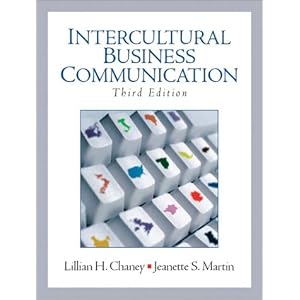
[Annotation blog post #3] Intercultural business communication - Lillian H. Chaney and Jeanetter S. Martin


  1. For this book, I choose three chapters that I think they can support for my topic: 1) The nature of intercultural communication, 2) Contrasting cultural values, and 3) Intercultural Negotiation Process. As the other sources, I found similar ideas about the intercultural business communications, but the authors of this book also give the business terms, which I found really interested for me. The authors also mentioned about the differences between cultures in verbal or nonverbal way. The considerations when a company expands internationally and multinational management orientations are the amazing information/issue about international business that I have never thought about.
  2. Quotes:
    1. “When a company expands internationally, they have to consider the consumers who are targeted to buy their product.” (14)
    2. “Negotiators, however, cannot escape their own cultural mind-sets. Even professional training cannot erase the deep-seated perceptions.” (197)
  3. The intercultural communication seems more complicated than I thought. For international business, intercultural communication will probably occur between party and party. But even for small business, or business do in the same country, the geography is one of the reasons cause to the different in culture. Religious is also one of the reasons. Even right now when people seem to be more open-minded and everyone (between different races, nationalities, gender, job status, etc.,) seems to be treated equally, but in reality, subtle distinctions are still made by non verbal way.
  4. The source brought up the terms that I found really helpful, I can use these terms to make my research paper’s tone seems more professional (I hope!) One more thing is about the use of interpreters and translators when do business internally ( positive effect is you have more time to think about next statements while the previous one is translated, but the negative effect is somehow your messages will not be translated fully because the different in language or can be because of the misunderstanding of the interpreters/translators)
  5. Both the authors are professors in university also published articles in professional journals. Both of them have experience working with intercultural as well as international issues, and their current job now is relevant to intercultural communication as well.
  6. Communication is the main topic in my three first posts. From international to intercultural communication, and even intracultural communication, the cultural differences possibly exist. They quite have similar ideas and appear repeatly, even though each source focuses more on specific issues. As an internationally-educated student, I want to go back to my home country and apply what I learned in US. But it seems not to be easy at all. That is why I want to focus more on intercultural communication, and hope can find ways to negotiate those cultural conflicts.

Work cited :

Chaney, Lillian H., and Jeanette S. Martin. Intercultural Business Communication. 3RD ed. Upper Saddle River (NJ): Prentice Hall, 2004. Print.

    Thursday, October 21, 2010

    [Annotation blog post #2] Promoting Intercultural Communication - Fareeda Ibad

    1. What I learn from reading this article that a company/business develops intercultural communication for two possible reasons: one is for the diversity in the system, and second is for international trading. However, the international business can bring the prospect growth, or harm the development of the business, if the business doesn’t know how to deal with the intercultural issues. By taking alert on our thinking (such as prejudgment, stereotypes), and move beyond our initial beliefs (can be ethnocentrism, cultural standpoints) we can limit the existence of racism, discrimination
    2. “As people are forced to think outside the box they develop greater interpersonal skills, flex their creative muscle and learn new ways of doing things.”
    “Being alert to potential problems is the first step toward understanding. Once problems have been identified it is easier to seek means of improvement.”
    3. Avoiding ethnocentrism, acknowledging other’s cultural beliefs can develop better interpersonal relationship with people, which come from different cultural backgrounds. Both in Trask’s and Ivanic’s essay, and the article I chose, the authors encourage people to understand, sympathy with others that have different background/gender/hierarchy/cultural standpoints, etc.
    4. As I mentioned in the previous post about how to “bridge the culture gap,” for this post I will go more detail in communication between people that have cross-culture with others. As we are living in a global business world, intercultural communicate skills are needed to connect with others from different parts of the world.
    5. I found this source and I am interested in it because I see some similar ideas with the source I found. This one develop more on the effect and importance of intercultural communicate skills. I think this source is credibility because it is written by an experience writer, who is the head of Communication Department in college of Business management. She also has firsthand experiences both in teaching communication and business.
    6. These two first posts bring to me the alert for the need of intercultural communication and acknowledgement in similarities and differences between culture and culture. Though both of the posts are about communication, the previous post in on bridging culture gap, which is more on practical, while this article, and focus more on theories.


    Work cited:

    Ibad, Fareeda Ibad. "Promoting Intercultural Communication - Articles -
    Brandsynario.com." Pakistan's Largest Advertising, Media and Marketing
    Resource | Brandsynario.com. Brandsynario. Web. 21 Oct. 2010.
    .
    .

    [Annotation blog post #1] Bridging The Culture Gap - Penny Carté and Chris Fox


    1. Writer’s main point is mostly about intercultural comparison. When having business with international clients, which have different cultural, and beliefs, it’s better for businessmen/businesswomen try to put themselves in their partner’s position in any situation. Knowing yourself and learn other’s beliefs will help you in communication and avoid the misunderstanding and false stereotypes.

    2. a) [f]ocusing on yourself and your own agenda is the major block to successful communication, whatever context you’re operating in (91)

    b)“[p]ut yourself in their shoes (position) at every stage.” (91)

    c)“You don’t see something until you have the right metaphor to perceive it.” (Thomas Kuhn) (89)

    d)“It just seems wrong to you because you’re looking at it from your own cultural standpoint.” (67)

    3. The idea that your point of view is not universal is concerned in the reading I read so far. And in business, especially with the international trading, learning others’ beliefs is necessary. The international clients have their own norms, beliefs, culture that they think is right, and they use those to treat/communicate/respond to other people. From this source, the writer also show how to respond to specific cultural (Western, Asian,etc.,) The writer gives “the guide to international business communication” in specific cases.

    4. The interested topic that I found in this book is about the international business communication. Communication is absolutely important in business. Even if you don’t do business with foreigners, the people in the same country also have different cultural standpoints. As a specialization of business, human resource manager is one of the careers I concern. So I think it is really helpful if I could understand how people interact, communicate with each other, especially between people have cross culture.

    5. The book provides the skills, understandings from the consultants, who have first hand experiences in working across “linguistic and cultural barriers.” The authors of this book are two of the directors of a company whose expertise lies in communication, so they probably are experts in their field.

    Communication is one of the required skills in business, which is my main topic. And as an international student, whether I will come back to my home country or decide to stay here, my cultural standpoints are affected. If I come back, my beliefs will be different from when I stayed in my home country years ago, because the norms in America are different from Vietnam, and even I try to maintain my own culture, there must be few changes, such as more open-minded, individualism oriented. But if I choose to stay in America and work, I still have my cultural beliefs in the depth of my heart. And in the next post, I will mention and focus more in intercultural business communication, which go more detail in my topic for communication in business.


    Work cited:

    Carté, Penny, and Chris J. Fox. Bridging the Culture Gap: a Practical Guide to Business Communication. London: Kogan Page, 2004. Print.


    Monday, October 18, 2010

    Initial Goals


    Below are some initial goals that I would like to see my research paper accomplishes:

    These are kinds of sources I am hoping to find from:
    1. Internet
    a. Businessman and business woman's articles/posts from blogs or personal website
    (especially who are well-known for his/her achievements/experiences
    b. Universities and college’s website
    c. Web newspapers
    2. Book
    a. Reference books
    b. Specialized Business books
    3. Others
    a. TV (news, talking shows, reality shows, interviews, etc.)
    b. Newspaper

    Sorts of disciplines/fields/majors that I look for information:
    1. Business
    2. Manager
    3. Leadership
    4. Communication
    5. Foreign Trade
    6. Computer science


    What I want to learn:
    What Business administrations is
    Possible job titles
    Salary
    Benefits
    Internship
    Cultural conflicts
    Skills and characteristics/traits needed
    Specializations
    Other certificates that support business administration

    Sunday, October 17, 2010

    Introduction


    Hi all!

    I am a Vietnamese, learning in America. My dream is to be an effective and dependable manager. In order to complete my dream, I need to start planning from today.

    I am studying at Cascadia community college right now, and thinking to transfer to UW Bothell for bachelor degree in business administration.

    I want to know more about the major I am heading to, which is business administration.

    What courses should I take to complete my degree? What are skills or traits or characteristics needed for a good manager? What are the possible jobs I can apply after having a degree in business administration? How much is the average salary? Does it matter if where I get my knowledge is America, while Vietnam is where I want to work and apply the job for?

    They are only few of tons questions that I, so do people, who are planning to study or taking business administration, want to explore.

    This blog is where I can share my ideas, as well as the questions and answers for who has same interest in business administration, or even want to be a member in business administration community.